
String Inverters vs. Microinverters
Don't let shade kill your solar production. We explain why Microinverters (Enphase) beat String Inverters for efficiency and safety.
Solar payback in your region — free estimate, instant calculator.
Open calculator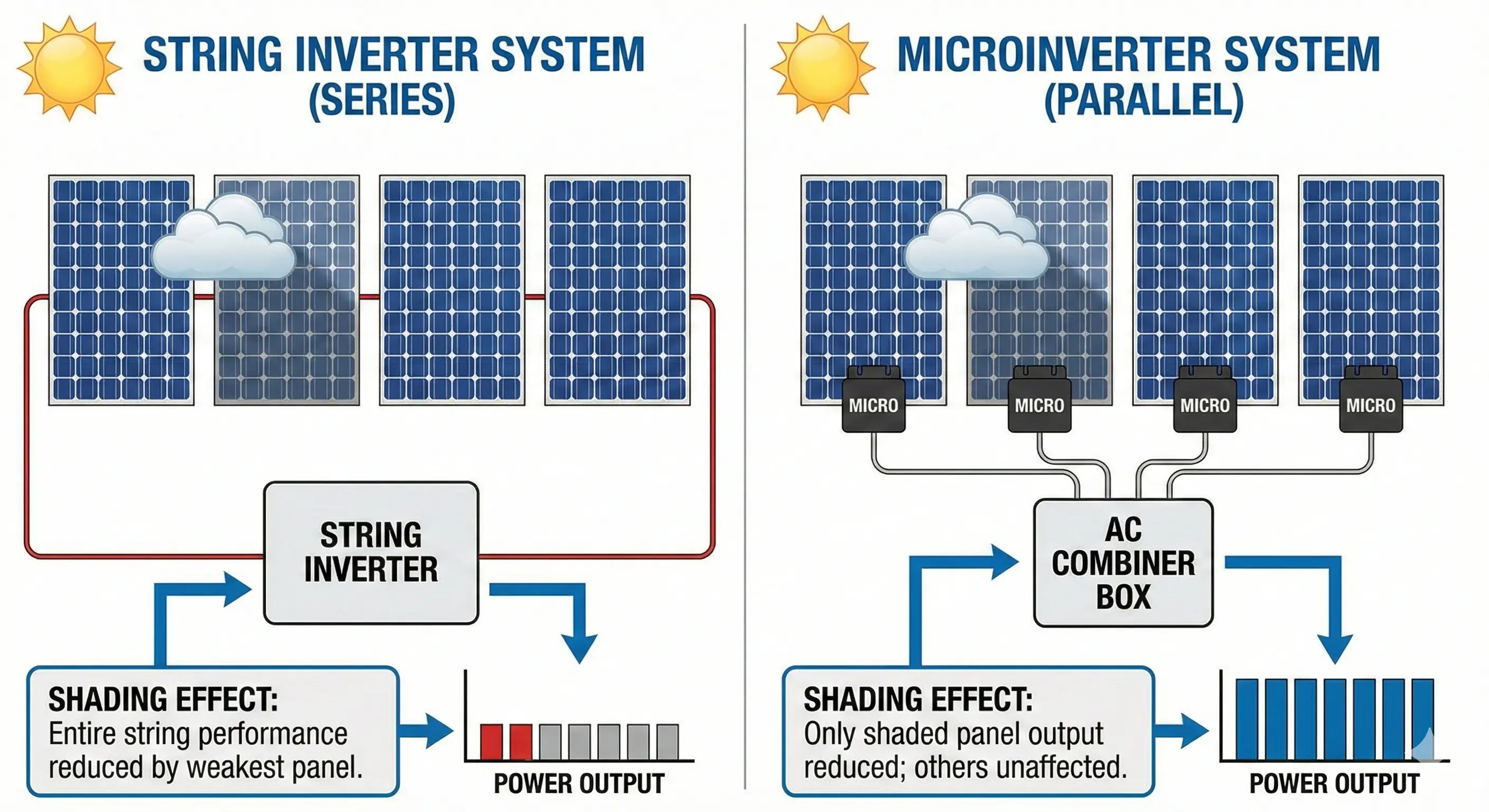
Your roof has a chimney. Or a tree nearby. Or a dormer window.
At 2:00 PM, a shadow creeps across the bottom corner of one solar panel.
The String Inverter Trap If you have a cheap "String Inverter" system, your power production just fell off a cliff.
Think of old-school Christmas tree lights. If one bulb burns out (or gets shaded), the entire strand goes dark. String inverters wire all your panels in a series. The system can only perform as well as its weakest link. If one panel drops to 10% output because of a shadow, the other 15 panels—even though they are in full sun—also drop to 10%.
The Microinverter Solution This is why Microinverters (like Enphase) took over the US residential market.
With Micros, there is a small computer attached to the back of every single panel. They work independently.
If Panel #1 gets shaded by the chimney, it drops to 10%. Panel #2, sitting right next to it in the sun, stays at 100%. You don't lose the whole array just because of one shadow.
Pro Tip From the Field "I sell Microinverters for safety, not just efficiency.
With a String Inverter (like the older SMA or Fronius models), you have 600 to 1,000 Volts of DC electricity running across your roof and down the side of your house. If a rat chews that wire, or a nail hits it, it arcs like a welder. It is dangerous.
With Microinverters, the power is converted to standard 240V AC (like your dryer outlet) right there on the roof. It is much safer for your family and for firefighters. If the grid goes down, the AC signal cuts instantly. There is no high-voltage DC lingering in the conduit. It’s peace of mind."
FAQ: Inverter Wars
- Q: Are Microinverters more expensive?
- A: Yes. Typically about 15-20% more upfront cost than a String Inverter. But the reliability and increased production usually pay for that difference in 3-4 years.
- Q: What about 'Optimizers'?
- A: Optimizers (like SolarEdge) are a hybrid. They fix the shading issue like micros, but they still rely on a single central inverter box on the wall. If that central box dies, the whole system dies. If one microinverter dies, you only lose one panel.
- Q: How long do inverters last?
- A: String inverters usually last 10-12 years. Microinverters are warrantied for 25 years. That’s a huge difference in long-term value."