
The Inflation Hedge: Fix Your Bill
Inflation is killing your budget. Solar is the only way to lock in your energy costs for 25 years. See the financial breakdown.
Solar payback in your region — free estimate, instant calculator.
Open calculator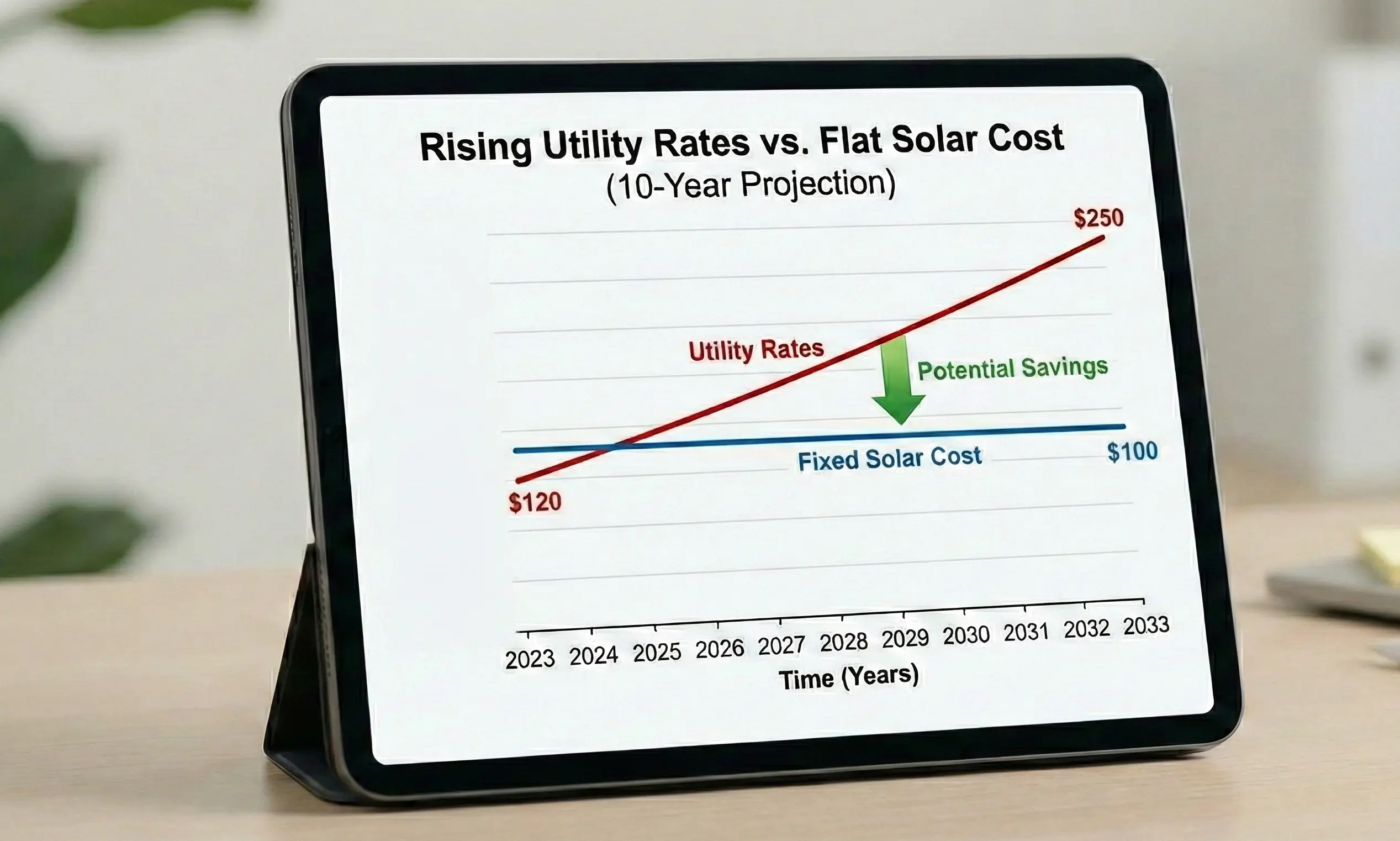
Gas prices go up. Milk goes up. Lumber goes up. You sit at the kitchen table clipping coupons to save fifty cents on pasta, yet you ignore the massive hole in the bottom of the financial bucket: the electricity bill.
Most homeowners accept rising utility rates as a fact of life, like death and taxes. They complain when the rate hikes hit, pay the bill, and move on. This is a financial mistake. The electric bill is currently the only major household expense that can be legally "fixed" for the next twenty-five years.
The 25-Year Gasoline Deal Imagine if a gas station offered a contract: pay a fixed price of $3.50 per gallon for the next 25 years. You pay it up front (or finance it). In year one, it feels normal. In year ten, when gas is $8.00 a gallon, you are still driving for $3.50. You look like a genius.
Solar is exactly that contract. It is a hedge against utility inflation. When you buy a system, you are locking in your Levelized Cost of Energy (LCOE).
The Math of LCOE Take the total cost of the system. Divide it by all the kilowatt-hours (kWh) it will produce over its warranted life. For a standard system today, that number usually lands around $0.06 to $0.08 per kWh.
The national average utility rate is hovering around $0.16, with some states like California or Massachusetts hitting $0.35 or more. And that rate never stays flat. Historically, utility rates rise about 3-4% annually. In recent years, due to aging grid infrastructure and wildfire liability, those hikes have jumped to 10-15% in some regions.
By going solar, you stop participating in that market. You exit the inflation loop. While neighbors complain about the new rate hike in 2030, a solar owner's cost remains frozen at the price they paid in 2025. It acts less like a home improvement and more like a high-yield, tax-free bond.
FAQ: Financial Reality Check
- Q: What if utility rates go down?
- A: History suggests this is virtually impossible. The US power grid requires trillions of dollars in upgrades to handle EVs and extreme weather. Those costs are passed directly to the consumer. Rates only go one direction: Up.
- Q: Is solar a better investment than the stock market?
- A: It is a safer one. The S&P 500 has risk. Solar savings are a guaranteed return on investment (ROI) based on avoided costs. Plus, the "earnings" (savings) are tax-free. To save $3,000 a year on bills, you'd need to earn $4,000 in salary and pay tax on it.
- Q: Does inflation affect my solar panels?
- A: Only if you wait to buy them. Hardware and labor costs track with inflation. Buying now locks in today's labor rates for tomorrow's energy.