
The Bird Nest Surprise
Pigeons and squirrels love solar panels. Learn why Critter Guards are mandatory to prevent fire hazards and roof damage from pests.
Solar payback in your region — free estimate, instant calculator.
Open calculator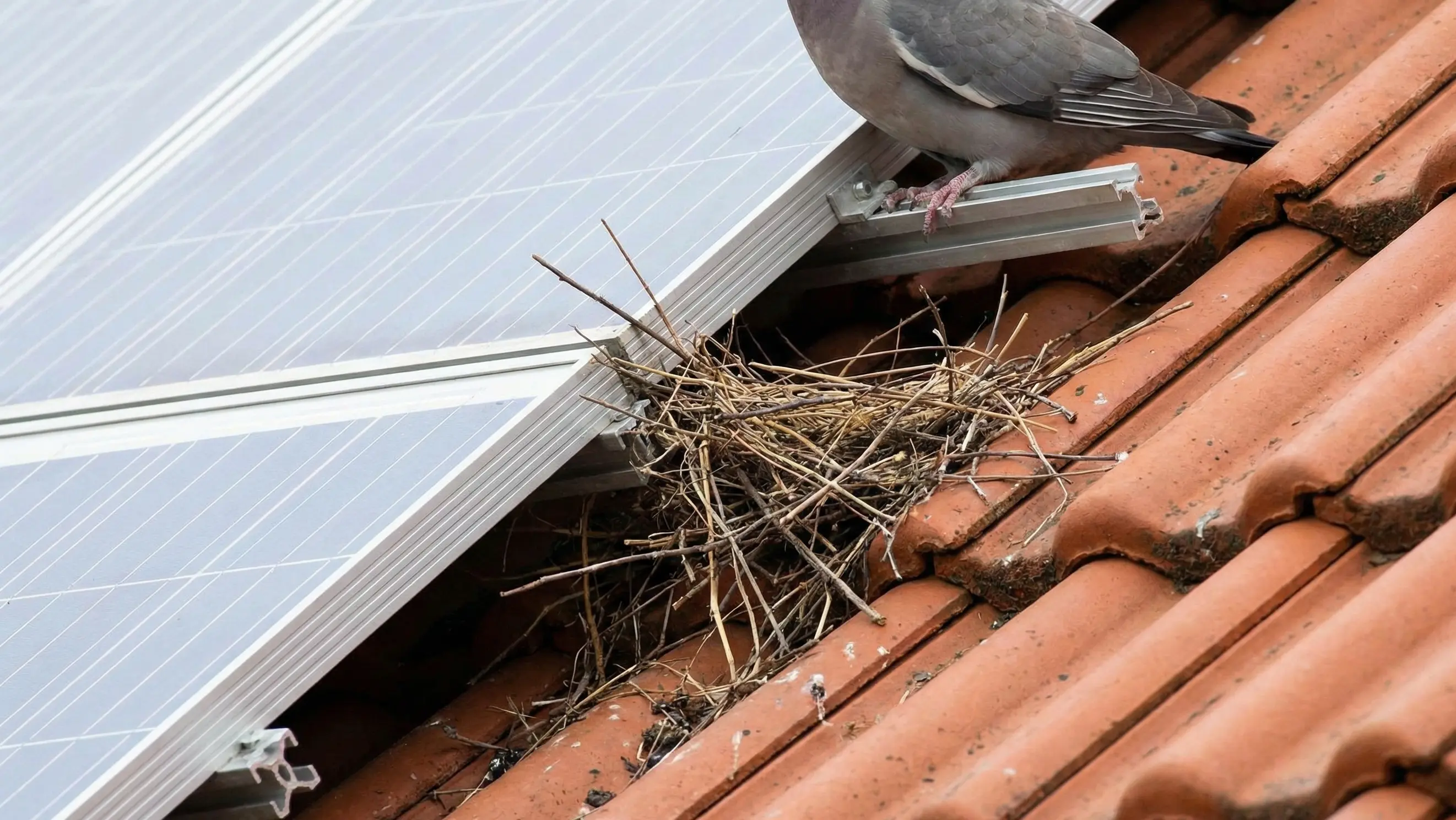
You spend $30,000 on a sleek, black solar array. It looks futuristic.
Six months later, you are sitting in the living room and you hear it. Scritch. Scratch. Coo.
You walk outside. There are pigeons everywhere. White streaks of poop are sliding down your roof and clogging your gutters. You have a pigeon infestation.
The Why Solar panels are mounted about 4 to 6 inches off the roof to allow for airflow. To a bird (or a squirrel), this is a 5-star hotel. It provides shade, protection from hawks, and warmth from the electronics.
It’s not just gross; it’s dangerous. Squirrels and rats have a nasty habit of chewing on PV wire insulation (which is often soy-based). I have seen entire arrays short out because a rodent chewed the neutral wire. The arc fault can start a roof fire.
The Fix: Critter Guards You need a physical barrier. A Critter Guard is a PVC-coated steel mesh that wraps around the perimeter of the array, closing that 4-inch gap.
Pro Tip From the Field "Do not—I repeat, DO NOT—let a handyman install chicken wire with screws. If you drill a single screw into the frame of the solar panel, you void the manufacturer's warranty instantly.
You need to use Omega Clips or J-Hooks. These are specialized clips that hook onto the lip of the panel frame and hold the mesh tight without drilling.
Install this with the system. It costs maybe $500 upfront. If you wait until the birds move in, I have to charge you $2,500. Why? Because I have to remove the panels, scrub the toxic bird poop off your shingles, repair the chewed wires, and then install the guard. Pay the $500 now."
FAQ: Pest Control
- Q: Does every house need critter guards?
- A: If you have large trees nearby or see pigeons in your neighborhood, yes. If you are in a new development with no trees, you might risk it.
- Q: Will the mesh reduce airflow?
- A: Negligibly. The mesh is open enough to let air pass but small enough to stop a squirrel.
- Q: Can I install it myself?
- A: It involves working on the edge of a sloped roof. Unless you have a harness and roofing experience, hire a pro."