
400 Holes in Your Roof? No Problem.
Terrified of holes in your roof? Learn how professional 'flashing' technology makes solar attachments watertight for decades.
Solar payback in your region — free estimate, instant calculator.
Open calculator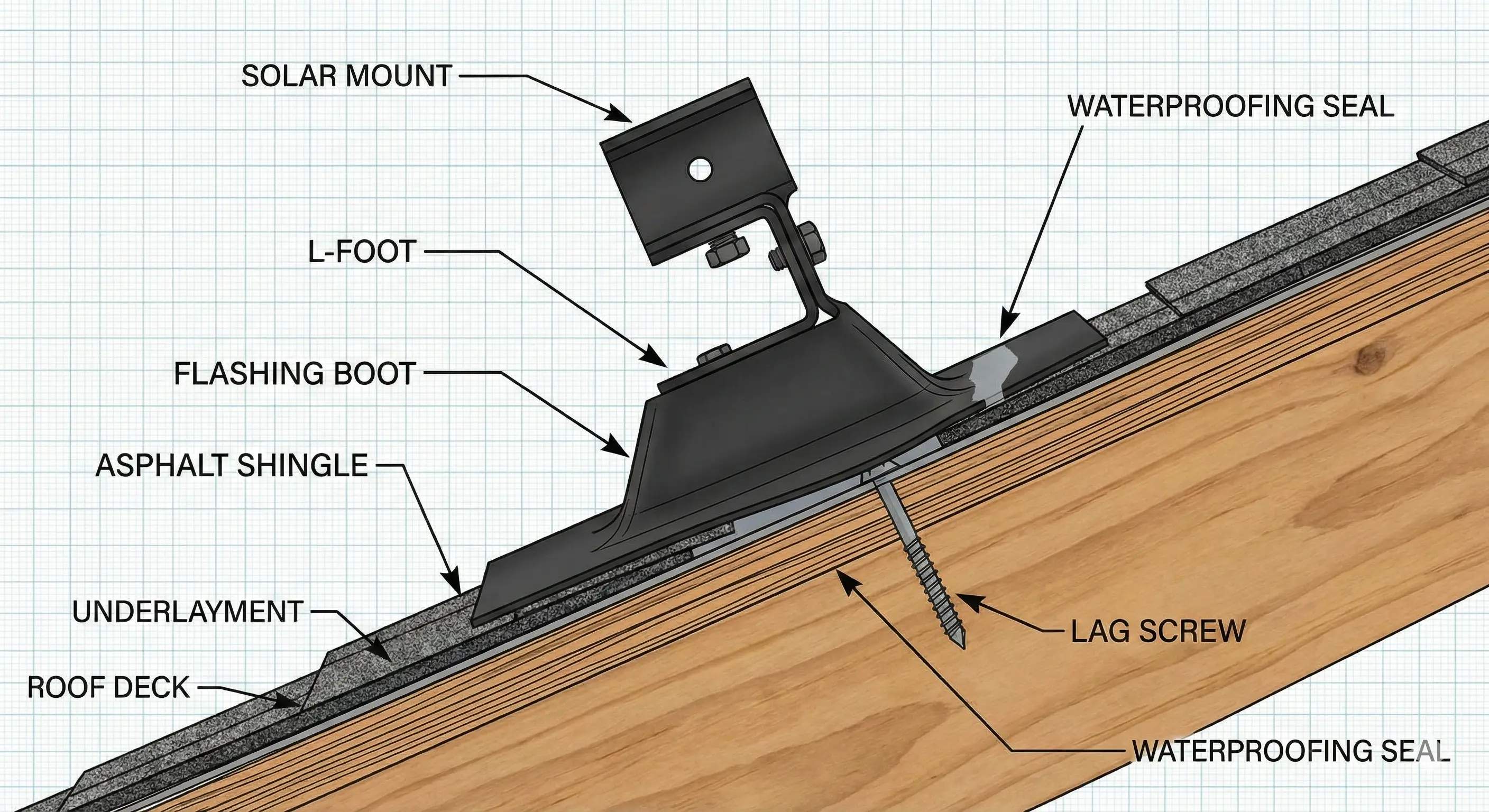
You look at the engineering plans. They call for 40 mounting brackets. That means 40 lag bolts driven straight through your shingles.
Your brain immediately screams: "My roof is going to look like swiss cheese. It’s going to leak. Mold. Rot. Disaster."
It is a rational fear. But in professional solar, leaks are actually incredibly rare. Why? Because we don't just drill holes and squirt some caulk in them.
The Magic of Flashing Amateurs rely on sealant. Pros rely on Flashing.
We use a piece of hardware called a "FlashFoot" (made by companies like IronRidge or Unirac). It is a sheet of aluminum that slides under the shingle above the hole and overlaps the shingle below it.
Think about how a roof works. Water runs downhill. By sliding the metal plate under the upper shingle, we ensure that water flows over the penetration, never into it.
The lag bolt itself passes through a raised, water-tight puck with a rubber EPDM washer that compresses when we torque it down. It is the same technology used to seal the plumbing vents that are already sticking out of your roof right now.
The Warranty Protection Any reputable installer will offer a separate 10-Year Penetration Warranty. This basically says: "If the roof leaks exactly where we drilled a hole, we pay to fix the roof and paint the water stain on your ceiling."
Pro Tip From the Field "Here is the secret nobody tells you: The leak doesn't come from the hole we drilled correctly. It comes from the hole we missed.
It’s called a 'Shiner'. That’s when the installer tries to hit the rafter, misses, and hits just the plywood. He pulls the bolt out and tries again. Now there is an empty hole in your roof hidden under the panel.
A lazy installer will fill that 'shiner' with silicone and pray. A pro will lift the shingle, slide a piece of sheet metal flashing underneath to cover the mistake, and seal it properly.
Ask your installer during the site survey: 'What is your protocol for missed pilot holes?' If they stare at you blankly, kick them off your property."
FAQ: Roof Worries
- Q: Can you install solar on a Tile Roof?
- A: Yes, but we don't drill through the tile. We remove the clay tile and swap it for a 'Tile Replacement Mount'—a metal tile with the bracket built-in. It’s watertight and unbreakable.
- Q: What about Metal Roofs?
- A: Metal is the best roof for solar. We use 'S-5! Clamps' that grab onto the standing seam. We don't drill a single hole. It is literally impossible for it to leak.
- Q: Will the weight of the panels collapse my roof?
- A: No. Solar adds about 2.5 lbs per square foot. Most roofs are engineered to handle 20+ lbs (for snow loads). It’s negligible weight."